Transformation
On former colliery land, decay is where new life begins. Fungi, slime moulds and other decomposers are the quiet engines of recovery, turning endings into beginnings as they break down fallen wood, leaves and dead plant matter and return their nutrients to the soil.
Most of this work happens out of sight. Fungal threads, finer than a hair, spread through wood and earth, digesting what has died and feeding the life that follows. On damp logs, slime moulds flow across the surface in search of food, forming networks so efficient they can solve mazes, all without a brain. When conditions change, they rise into delicate, bead-like spore cases that last only days.
There is a striking contrast with the land’s past. Coal formed where ancient plants were buried before they could decay, locking their carbon away for millions of years. These organisms do the opposite, keeping matter moving through the living world rather than letting it lie buried.
Seen up close, decay is also beautiful: the branching of a fungus, the sheen of a slime mould, the textures of wood returning to soil. These images invite a closer look at a process of change that, in these landscapes, never stops.

Snowy Ink Cap (Coprinopsis nivea) This small white mushroom, dusted with a mealy, snow-like coating, grows on dung, especially horse and cow droppings. Beneath the cap, crowded gills fall like the folds of a pleated skirt, darkening from white to black as the spores ripen. It appears overnight and lasts only a day or two before its cap deliquesces into black ink, releasing spores as it dissolves. On restored colliery sites, horses ridden through the reserves leave dung that feeds a community of decomposers, from beetles and bacteria to fungi like this one, recycling nutrients into the food web. Its larger relatives, such as the common ink cap, were once used to make writing ink, said to deter forgers because the spores in it could be seen under a microscope. Coal formed where ancient swamp plants escaped decay. The snowy ink cap is part of the opposite story: decay returning life to ground once shaped by mining.

This branching white network is mycelium, the main body of a fungus. It is made of hyphae, threads far finer than a human hair. Mycelium grows through and across wood, leaf litter and soil, releasing enzymes that break down plant material outside its body, then absorbing the nutrients it releases. The cords act as transport routes, moving water and nutrients across the network. The mushrooms we see are only the fruiting bodies; the mycelium is where most of the fungus's life takes place, usually out of sight. On restored colliery sites, networks like this run through deadwood and soil, decomposing fallen timber and recycling nutrients. Some fungi also form partnerships with tree roots, helping young woodland establish on poor ground. In the darkness of mines, fungal threads growing through timber sometimes made the wood glow, and miners recorded this "glowing wood" as far back as the 18th century. There is an echo of the mines here. Beneath this land, miners once worked through a network of tunnels and roadways to reach the coal. Now another branching network spreads through the ground, not extracting but recycling, turning dead wood back into the living landscape.

Velvet Shank (Flammulina velutipes) This mushroom grows in clusters on dead and dying broadleaf wood, especially willow, elm and ash. Its glossy orange-brown cap is sticky when wet, while its stem is covered in fine velvety hairs, darkening to near-black at the base. Unusually, it fruits through the coldest months, from late autumn to early spring, and can survive being frozen, resuming growth when it thaws. On restored colliery sites, willow is often among the first trees to colonise old spoil. As these trees age and die, velvet shank helps break down their wood, including the tough lignin, returning nutrients to the soil and creating habitat for insects and other wildlife. The pale, long-stemmed enoki mushroom sold in shops was long thought to be a cultivated form of velvet shank, grown in the dark. DNA studies published in 2018 showed that it is in fact a separate, closely related species from East Asia, Flammulina filiformis. Coal is the remains of ancient wood that escaped decay. The velvet shank does the opposite, rotting wood back into the living landscape, bringing a flash of colour to the reserve in the depths of winter.

Yellow Stagshorn (Calocera viscosa) This bright yellow-orange fungus branches like a small set of antlers, which gives it its common name. It is a jelly fungus, tough and rubbery rather than brittle, and slightly sticky when wet, as its species name, viscosa, suggests. It grows on rotting conifer wood, usually stumps and buried roots, so it often appears to sprout straight from the ground. It fruits mainly from late summer to early winter. Yellow stagshorn is a brown-rot fungus. It breaks down the cellulose in wood but leaves much of the tougher lignin behind as a brown, crumbly residue. This residue breaks down slowly and adds long-lasting organic matter to the soil. Conifers had a direct link to the pits: much of the timber used for pit props was pine and larch, and wartime shortages of pit props helped lead to the founding of the Forestry Commission in 1919. They also tell a more complicated story. When colliery sites were reclaimed, fast-growing conifers were often planted because they could cope with poor, acidic spoil and green the land quickly. Alongside the levelling of spoil heaps and the clearing of pit buildings, they also hid much of the visible evidence of the industry that shaped these places and their communities. Now, rising like small golden antlers from fallen conifer wood, fungi like this one are breaking down the remains of that first planting.
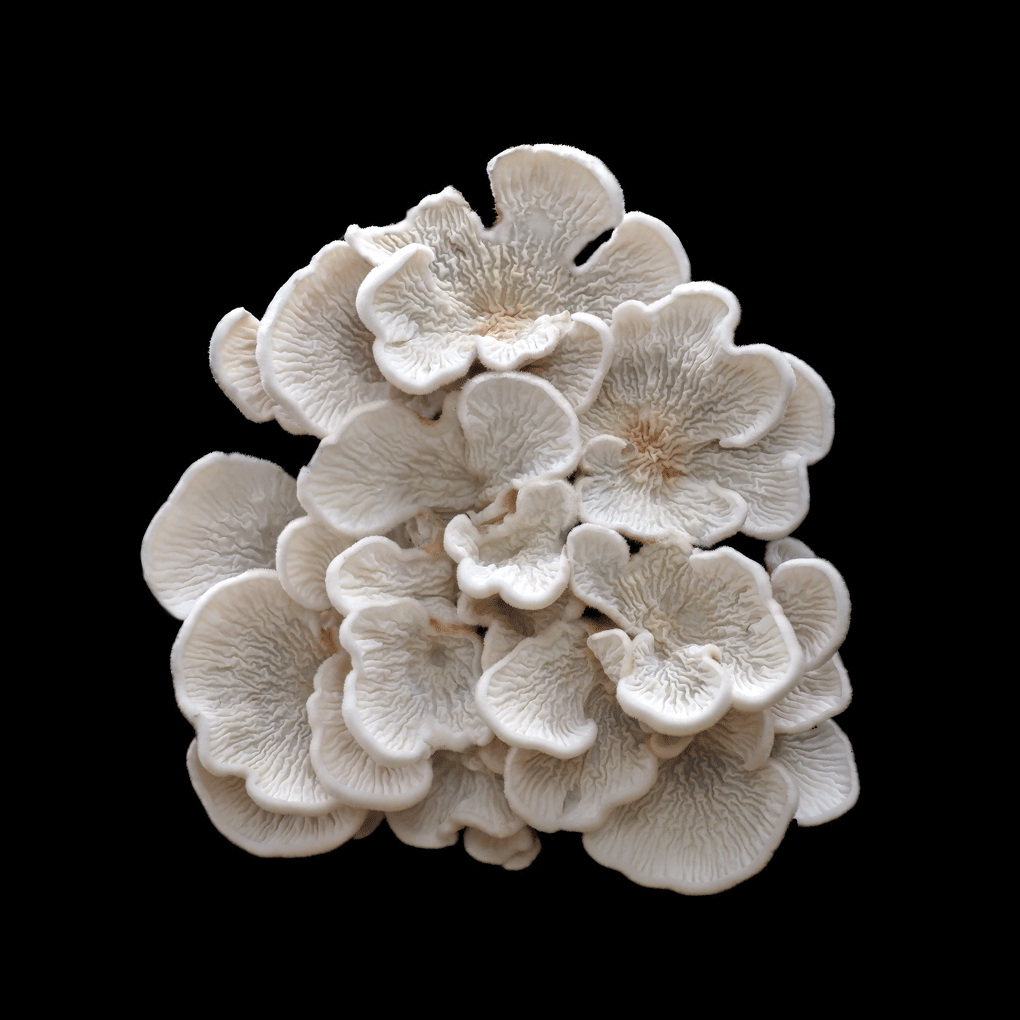
Crimped Gill (Plicaturopsis crispa) This small bracket fungus grows in tiers of fan-shaped caps, each only one to three centimetres across, on dead branches of broadleaf trees, especially birch and beech, as well as hazel and alder. From above, the caps are banded in orange-brown, fading to a pale edge. Underneath, as seen here, there are no true gills, only narrow, wavy folds that branch and crinkle like crimped fabric, which gives the fungus its name. It is one of the first fungi to colonise fallen branches, starting the work of decay by breaking down the wood's tough lignin. After a few years, stronger decomposers such as turkeytail usually take over, continuing the process. Once scarce in Britain, the crimped gill has spread widely in recent decades, with most British records dating from after 2000. On former colliery land, the birch that colonised bare spoil now drops its dead branches, giving this newcomer a place to grow.

Slime Mould These glossy white beads are the fruiting bodies, or sporangia, of a slime mould, gathered on damp, decaying wood. Slime moulds are not fungi but amoeba-like organisms. For most of their lives they live hidden in rotting wood and leaf litter as a moving, feeding mass called a plasmodium, grazing on bacteria, yeasts and fungal spores. When food or moisture runs short, they transform into structures like these, which ripen, change colour and release spores into the air. In the deadwood of restored colliery woodlands, slime moulds play a quiet role in the decomposer community, helping regulate the microbes that break down fallen timber. One slime mould, Physarum polycephalum, became famous when researchers found it could solve mazes and form networks resembling the Tokyo rail system, despite having no brain. Here, pearl-white against blackened wood, they recall a landscape where dark ground has given way to new life.

Common Puffball (Lycoperdon perlatum) This pear-shaped fungus is white when young and covered in tiny cone-shaped spines, like scattered pearls, which rub off to leave a net-like pattern. As it matures, it turns brown, its insides become a mass of powdery spores, and a small hole opens at the top. When a raindrop or a passing foot strikes it, a puff of spores bursts out into the air. It feeds on decaying leaf litter and wood, recycling the nutrients locked inside them. It has collected some memorable names, including devil's snuffbox and blindman's bellows. Its genus name, Lycoperdon, comes from the Greek for "wolf" and "to break wind," a nod to its puffs of spores. Coal formed where ancient plants were buried before they could decay, locking their carbon away for millions of years. The puffball is part of the opposite process: by breaking down dead plant material, it returns carbon to the air and nutrients to the soil, keeping the cycle turning.

Candlesnuff Fungus (Xylaria hypoxylon) These slender, often antler-like fingers rise in groups from dead stumps and fallen wood of broadleaf trees, and can be found all year round. Their bases are black and velvety, while the tips are dusted with white powder. This powder is made of asexual spores, released early in the fungus's life. Later, the fingers turn wholly black as a second, sexual stage of spores develops inside. It is one of the most common fungi on dead wood in Britain, helping break down stumps and branches and return their nutrients to the soil. Its name comes from its resemblance to a candle wick that has just been snuffed out, black at the base and white at the tip. That is a fitting image for former colliery land. Early miners worked underground by candlelight, a deadly danger in seams that gave off flammable gas, until safety lamps, including the "Geordie lamp" designed by George Stephenson, made the pits safer.

Oysterling (Crepidotus species) These tiny white caps, most no bigger than a fingernail, grow scattered along dead twigs and small branches, often on the underside. Each is attached at one side, with little or no stem, and is shaped like a small ear or kidney. Beneath the downy white surface, fine gills radiate from the point of attachment, turning from white to clay-brown as their brown spores ripen. The genus name, Crepidotus, is usually explained as "slipper ear," from the shape of the caps. Oysterlings are saprotrophs, feeding on fallen twigs, small branches and plant debris that larger fungi often pass over, and returning their nutrients to the soil. Despite their name, they are not closely related to the larger oyster mushrooms. On former colliery land, maturing woodland now sheds a steady fall of twigs and branches. Easily overlooked, these small fungi are part of the work that turns that fallen wood back into soil.

Velvet Shank (Flammulina velutipes) Its scientific name describes it well. Flammulina means “little flame,” for the glowing orange of its caps, and velutipes means “velvet foot,” for the dense, dark hairs that coat the lower stem. Growing in tight clusters, the caps are glossy and slightly sticky in wet weather, while the gills beneath stay pale cream to yellowish, and the stems darken from tawny near the top to almost black at the base. Velvet shank is one of the few mushrooms that grows through winter. Frost does not stop it: a cluster can freeze solid on a January night and simply carry on growing when it thaws. When little else is fruiting, it offers food and shelter to small invertebrates such as fungus gnats and springtails. It is often found on dead elm, and the loss of millions of elms to Dutch elm disease left plenty of the deadwood it thrives on. Although it is edible, it can be confused with the deadly funeral bell, which also grows in clusters on wood, so it should never be picked to eat without expert identification.